Governing Abacus: Scaling a Design System Across Platform and Product
Overview
As a Product Designer at BMO, I contribute to the evolution and governance of Abacus, the design system supporting all public-facing digital experiences.
While Abacus existed prior to my involvement, it has since expanded significantly in structure and scale. I contributed to refining the system and enabling teams to use it consistently across multiple lines of business.
Operating at the intersection of platform and design systems, I help maintain foundational and module libraries while supporting teams across the organization.
Problem
As multiple teams contributed to public-facing products:
UI patterns diverged across lines of business
New modules introduced risk of inconsistency
Designers lacked clear guidance on how to use Abacus effectively
Alignment between teams became difficult to maintain
Opportunity
There was an opportunity to strengthen Abacus beyond a shared library — into a scalable system with clear structure, governance, and adoption.
This meant:
Defining ownership across system layers
Enabling reusable, flexible modules
Supporting designers in working within the system
Ensuring new patterns contributed to the system rather than fragmenting it
Approach
Structure & Ownership
Abacus is composed of multiple interconnected layers:
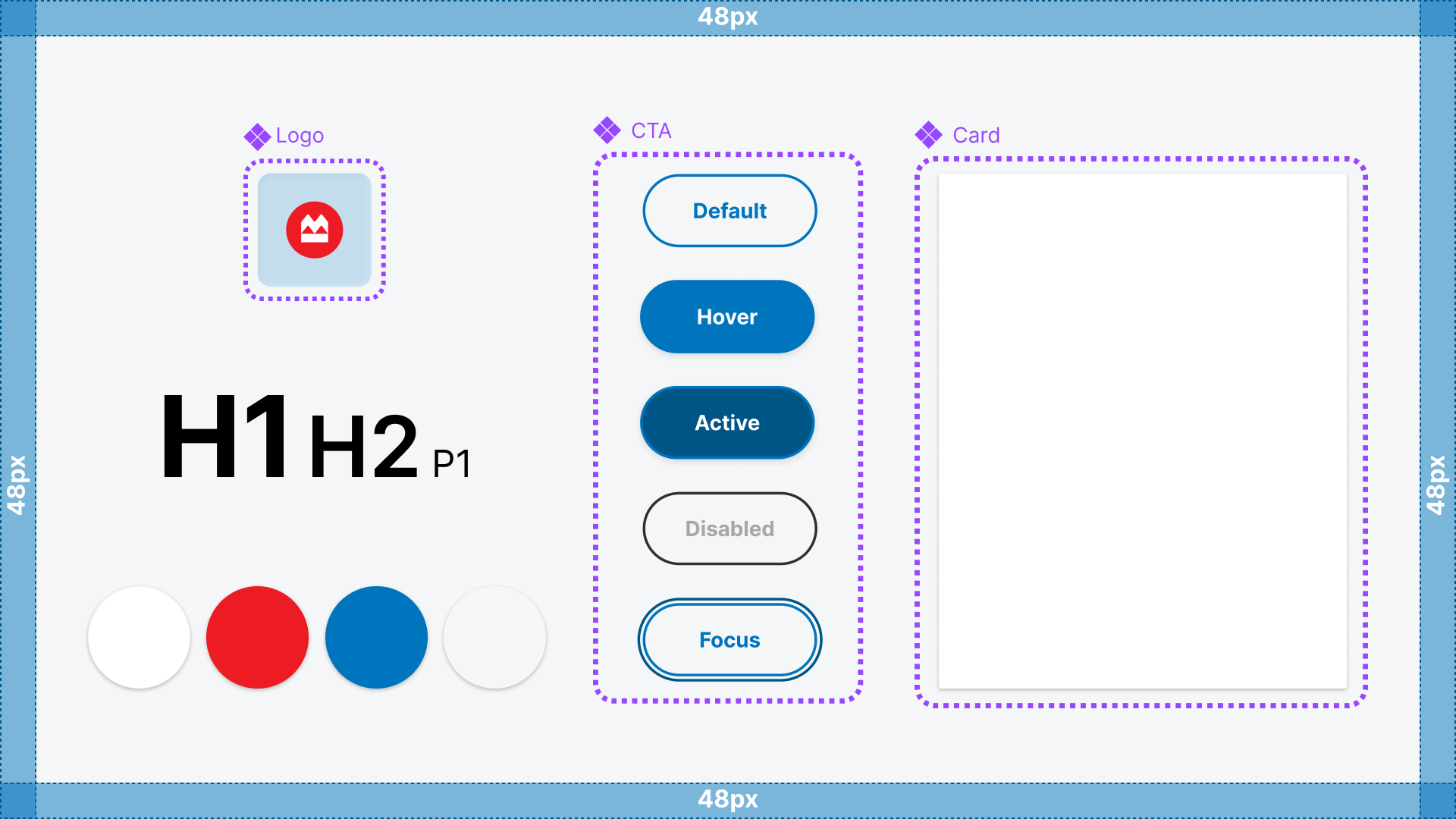
Abacus Common Library(org-wide, DS team)
Brand Assets(icons, illustrations, visual assets)
Abacus Foundations Library(platform-owned: type, color, components)
Abacus Public Library(platform-owned: CMS-ready modules)
My role spans these layers, contributing to both platform implementation and system governance.
Approach
Governance
To maintain system integrity, all net-new modules are reviewed through our team.
Designers across LOBs submit module requests for intake
Designs are evaluated against Abacus standards, accessibility, and platform constraints
Existing modules are prioritized where possible before introducing new ones
Approved modules are refined and added to the shared library
This ensures new patterns are consistent, scalable, and reusable across Abacus.
Approach
Enablement
Beyond governance, I support teams in effectively using Abacus:
Train designers working on public-facing products
Provide guidance on module and component usage
Act as a point of contact for system-related design questions
Consult with DMs and POs on migration and implementation
This enables teams to move faster while staying aligned with Abacus.
System in Practice
Abacus enables teams to:
Build using shared components and modules
Maintain consistency across lines of business
Apply accessibility standards by default
Reduce duplication and design debt
Impact
Improved consistency across public-facing experiences
Established a structured intake and review process for new modules
Enabled teams to design within system constraints
Reduced duplication and design inconsistencies
Strengthened alignment between platform and design system teams
Reflection