Designing a Scalable Module Library for Abacus
Overview
As a Product Designer at BMO, I contribute to the design and evolution of the Abacus module library, a system of reusable modules used to build public-facing pages in Contentful.
Built on shared foundations and components, the library empowers designers across lines of business to efficiently create consistent, scalable experiences without custom development.
Problem
As product and marketing needs evolved:
Designers needed to build pages quickly across multiple LOBs
New requests often led to one-off solutions
Existing modules didn’t always support edge cases
Designers lacked visibility into how modules behaved in Contentful
Approach
Enablement & Structure
Modules are designed to empower designers, not restrict them.
Each module:
Is built using Abacus foundations and components
Includes multiple properties and variants
Supports responsive behavior across breakpoints
Mirrors functionality available in Contentful
This allows designers to:
design once, and confidently translate that into production
Approach
Reuse & Decision-Making
Reuse is the guiding principle.
When new requests are introduced, we evaluate:
Can an existing module solve this?
Can we extend an existing module instead?
Can multiple modules be combined?
We actively push back on one-off solutions. New modules are only introduced when they:
Provide value beyond a single use case
Are reusable across LOBs
Align with system and business needs
Approach
Governance, Documentation & Alignment
The module library evolves intentionally and is supported by strong documentation.
All net-new modules are reviewed through our team
Modules are refined, consolidated, or expanded before being added
Module behavior, variants, and usage are documented in Confluence
Designers, developers, and content strategists contribute to documentation
Naming conventions align across Figma and Contentful
To support this, I introduced:
Info Cards with Embedded Changelogs
Each module includes:
Functionality and variant documentation
Change history for transparency
Links for testing in Contentful
This ensures teams can:
access, understand, and apply the system independently
System in Practice
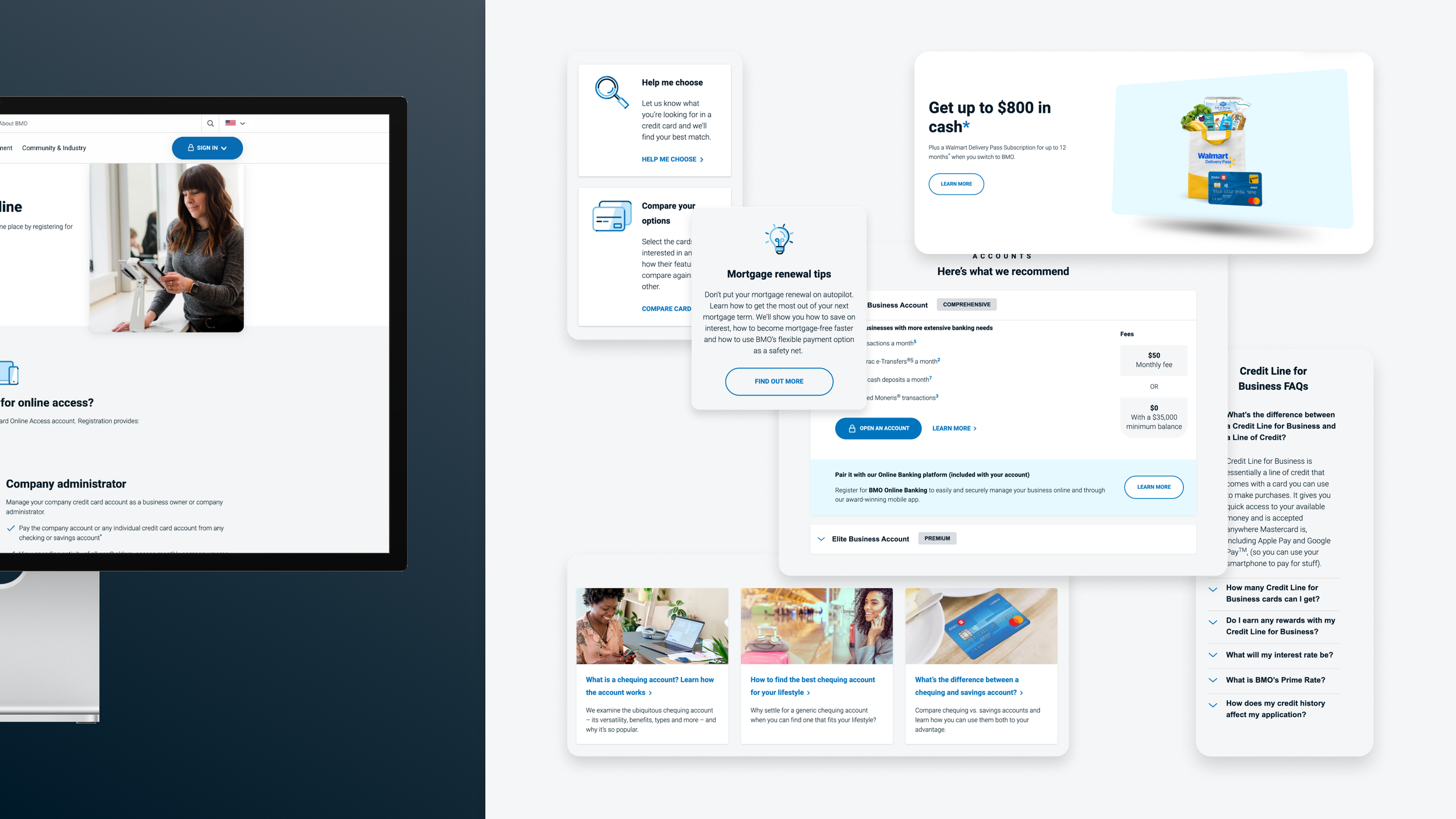
The module library includes patterns such as:
Hero banners
Content banners
Card grids
Accordions
Tables
Etc.
Modules are:
Responsive across breakpoints
Configurable through multiple variants
Designed to support a wide range of use cases
They also serve as:
a foundation and source of inspiration for future modules
Impact
Empowered designers to efficiently build pages across multiple LOBs
Reduced reliance on one-off solutions and custom development
Increased consistency across public-facing experiences
Improved alignment between Figma and Contentful
Enabled scalable decision-making through a reuse-first approach
Strengthened the system through documentation and intentional evolution
Reflection